Stage, not existence
Every instrument is placed on the path from tabled proposal to operating statute, so you can see whether it actually binds yet.
AI Policy Radar
The Radar tracks which climate commitments have crossed into enforceable law: classified by legal stage, jurisdiction by jurisdiction, with every record checked against the document it cites.
31 instruments
25 jurisdictions
27 in force
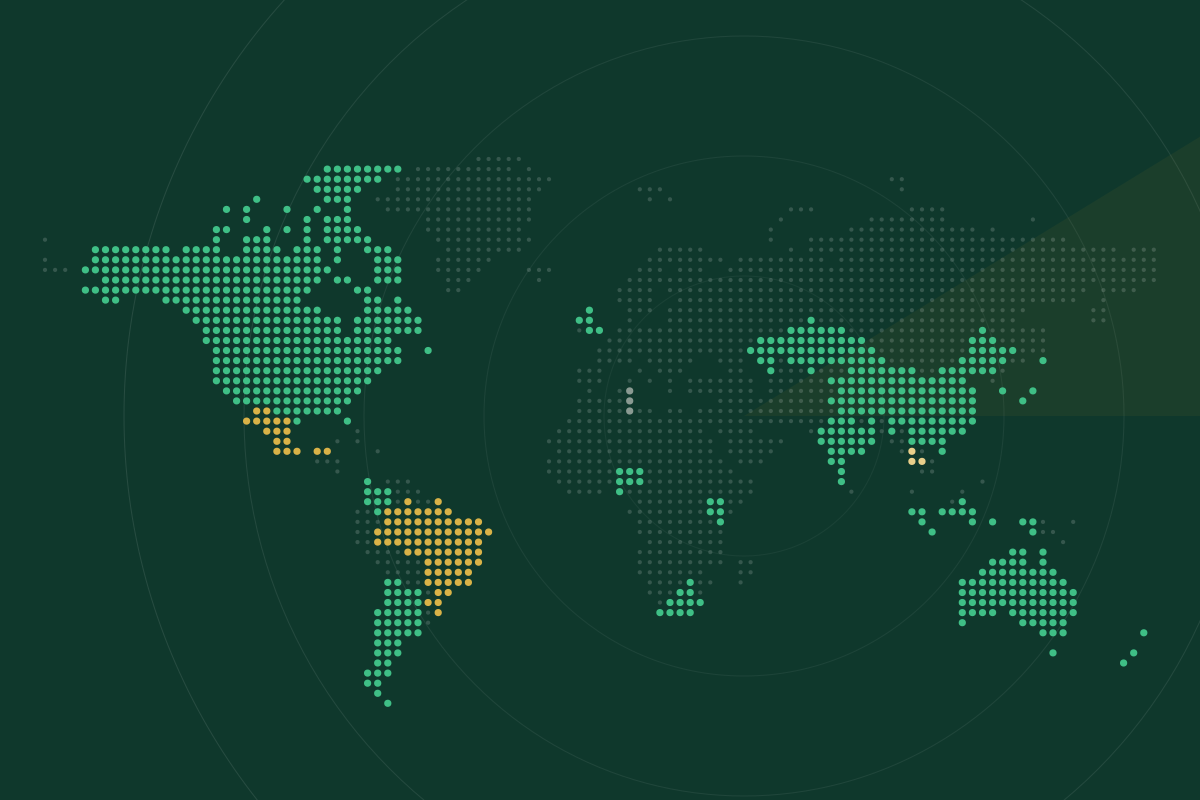
Select a country on the map, or filter by legal stage. Each row opens the record, its legal reference and its source.
Records last verified 4 October 2026
1.9 years: the median time from first proposal to entry into force, across 7 instruments where both dates are documented.
Each dot is a dated milestone checked against a public source; open a record to see the sources. Where a source gives only a year or a month, the dot sits mid-year or mid-month.
31 decisions, deadlines and reviews to watch on the tracked instruments. Each comes from the record’s source. Follow updates (RSS)
Argentina In force
The annual inflation updates of the tax amounts and the executive decrees that set the applicable amounts, and any reform of fuel taxation ahead of the 2035 end date.
Australia In force
The review of the mechanism's policy settings by the Department of Climate Change, Energy, the Environment and Water in 2026–27.
Brazil In rulemaking
According to ICAP, a public consultation on sector coverage was scheduled for July 2026, with final coverage and the remaining secondary regulations targeted for the end of 2026 and full operation for 2031. Brazil joined ICAP as its 36th member in February 2026.
California (United States) In force
Linkage with Washington's program under the agreement signed on 25 June 2026, which requires positive linkage findings by the Governor and a CARB rulemaking; the jurisdictions expect a linked market to begin operating in 2027.
Canada In force
Progress and assessment reporting against the 2030 target, the emissions reduction plan for 2035, and the setting of the 2040 target ten years ahead of that milestone.
Canada In force
The updated federal benchmark that the government said it would publish later in 2026, consultation on amendments to the OBPS Regulations, and the Canada–Alberta implementation agreement of 15 May 2026, which recognises Alberta's TIER price trajectory as matching the federal one.
Chile In force
Updates of the Long-Term Climate Strategy that assign budgets for later periods, adoption and review of sectoral plans and implementing regulations, and the five-yearly evaluation of the neutrality goal.
China In force
Guidelines issued on 25 August 2025 by the General Offices of the CPC Central Committee and the State Council aim for the national ETS to cover all major industrial emitters by 2027, to start moving sectors with stable emissions to absolute caps from 2027, and to operate a cap-and-trade system combining free allocation and auctioning by 2030.
Colombia In force
Decree 0969 of 4 August 2026 formalised a national tradable emission allowance programme (PNCTE) with a pilot from January 2027 to December 2029 and full operation from January 2030; the carbon tax rate is to serve as the floor price for allowance auctions. Sector coverage and thresholds for the programme have not yet been specified.
India In force
The launch of Carbon Credit Certificate trading on power exchanges, which ICAP reported as expected by mid-2026 (not confirmed on an official source at the time of verification), notification of targets for the remaining sectors, and the first compliance cycle for 2025–26.
Indonesia In force
Implementing regulations under Presidential Regulation No. 110/2025, resumption of allocation for Phase 2, and the operation of the carbon levy backstop.
Japan In force
Publication of baselines and allocation rules, the first compliance cycle for FY2026 emissions, a GX surcharge on fossil fuels scheduled from FY2028, and auctioning of allowances for high-emitting power companies from FY2033.
Kazakhstan In force
Final adoption of the Phase 6 national allocation plan, the introduction of auctioning, and installation-level allocations within the 2026–2030 carbon budget.
Kenya In force
Authorisations under bilateral Article 6 agreements, the operation of the national carbon registry, and the application of benefit-sharing rules to carbon projects.
Mexico In rulemaking
Publication of the definitive operational-phase rules. In September 2026 Semarnat's Director General of Climate Action Policies said the rules would be issued by early 2027, introducing economically enforceable obligations, allowance auctions and stronger monitoring.
New Zealand In force
2026 auction settings (reserve price NZD 71; first cost containment reserve trigger NZD 201) and changes announced in late 2025 to reduce compliance costs and to remove the requirement for unit supply settings to accord with the Nationally Determined Contribution.
Nigeria In force
Approval and publication of the five-year carbon budget and action plan, and the development of domestic carbon pricing instruments under the 2025 policy.
RGGI participating states (United States) In force
Adoption of the 2025 Model Rule in state regulations ahead of the 2027 cap, and Virginia's participation in regional auctions.
Republic of Korea In force
Subordinate regulations implementing the amendment, passed together with a new Climate Adaptation Act, and the fixing of specific values within the 2040 and 2045 ranges, reported to be due by 30 June 2031 and 30 June 2036 respectively.
Republic of Korea In force
The operation of the K-MSR and the higher auction share during Phase 4, and annual allocation decisions within the Phase 4 cap.
Singapore In force
The rate path toward S$50–80 per tonne by 2030, and the treatment of international carbon credits and transition allowances in later rate periods.
South Africa In force
Rate adjustments in future budgets, the treatment of tax-free allowances, and how the tax operates alongside the company carbon budgets provided for in the Climate Change Act 22 of 2024.
South Africa In force
Proclamation of the deferred provisions, including those on sectoral emissions targets, publication of the targets, and the allocation of carbon budgets to significant emitters.
Switzerland In force
Implementation of the revised CO2 Act, including exemption arrangements for companies and the use of levy revenue.
Thailand Proposed / announced
Submission to Parliament, passage and publication in the Royal Gazette. ICAP reports that enforcement is anticipated in 2027, with data collection in 2027–2028 and a pilot ETS potentially launching in 2029; Thailand has run a voluntary ETS (Thailand V-ETS) since 2013.
Tunisia No binding instrument
Whether a carbon tax proposal emerges from the DGELF feasibility work in a future finance law. A tabled bill or finance-law article would move this record to the 'proposed' stage.
United Arab Emirates In force
Implementing resolutions and MOCCAE reporting methodologies, the operation of the National Carbon Credit Registry, and Cabinet-set sectoral reduction targets.
United Kingdom In force
The policies the government sets out to meet the newly legislated 2038–2042 budget, and the independent progress assessments of the Climate Change Committee.
United Kingdom In force
Waste incineration and energy-from-waste facilities are planned to enter from 2028 after a monitoring-only period from 2026, and engineered greenhouse gas removals from 2029. The post-2030 cap trajectory for the second phase (2031–2040) is the next major design decision.
Viet Nam In force
The first surrender of allowances for 2025 emissions, trading activity on the exchange, and preparations for auctioning and wider coverage from 2029.
Washington (United States) In force
California and Québec's remaining steps — positive linkage findings by California's Governor and a CARB rulemaking; in Québec a rulemaking, approval of the agreement by the National Assembly and ratification — before the linked market begins, which the jurisdictions expect in 2027.
Choose up to three countries to see their instruments side by side.
31 shown
| Brazil | Brazilian Greenhouse Gas Emissions Trading System (SBCE)International Carbon Action Partnership (ICAP) | In rulemaking |
| California (United States) | California Cap-and-Invest Program (formerly Cap-and-Trade)International Carbon Action Partnership (ICAP) | In force |
| Canada | Canadian Net-Zero Emissions Accountability ActJustice Laws Website (Government of Canada) | In force |
| Singapore | Carbon Tax (Carbon Pricing Act 2018)National Climate Change Secretariat (NCCS), Singapore | In force |
| South Africa | Carbon Tax (Carbon Tax Act, 2019)National Treasury, Republic of South Africa — 2026 Budget Review, Chapter 4 | In force |
| China | China National Emissions Trading SystemInternational Carbon Action Partnership (ICAP) | In force |
| Kenya | Climate Change Act — Regulation of Carbon Markets (Climate Change (Amendment) Act, 2023)Kenya Law — Climate Change Act, Cap. 387A, consolidated as at 15 September 2023 (FAOLEX copy) | In force |
| United Kingdom | Climate Change Act 2008 — 2050 net zero targetlegislation.gov.uk (The National Archives) | In force |
| South Africa | Climate Change Act 22 of 2024South African Government (gov.za) — Minister's statement on proclamation, 17 March 2025 | In force |
| Nigeria | Climate Change Act, 2021Grantham Research Institute — Climate Change Laws of the World | In force |
| Switzerland | CO2 Levy on Thermal Fuels (CO2 Act)Federal Office for the Environment (FOEN/BAFU) | In force |
| Thailand | Draft Climate Change ActDepartment of Climate Change and Environment (DCCE), Thailand | Proposed / announced |
| Indonesia | Economic Value of Carbon (NEK) Trading Scheme — power sector ETSInternational Carbon Action Partnership (ICAP) | In force |
| United Arab Emirates | Federal Decree-Law No. 11 of 2024 on the Reduction of Climate Change EffectsGrantham Research Institute — Climate Change Laws of the World | In force |
| Canada | Federal Output-Based Pricing System (OBPS)International Carbon Action Partnership (ICAP) | In force |
| Republic of Korea | Framework Act on Carbon Neutrality and Green Growth for Coping with Climate CrisisMinistry of Climate, Energy and Environment, Republic of Korea (press release, 26 Aug 2026) | In force |
| Chile | Framework Law on Climate Change (Law No. 21,455)Biblioteca del Congreso Nacional de Chile — official text of Law No. 21,455 (digitally signed copy) | In force |
| India | Indian Carbon Credit Trading Scheme (CCTS) — compliance mechanismInternational Carbon Action Partnership (ICAP) | In force |
| Japan | Japan GX Emissions Trading System (GX-ETS) — mandatory phaseInternational Carbon Action Partnership (ICAP) | In force |
| Kazakhstan | Kazakhstan Emissions Trading System (KAZ ETS)International Carbon Action Partnership (ICAP) | In force |
| Republic of Korea | Korea Emissions Trading Scheme (K-ETS)International Carbon Action Partnership (ICAP) | In force |
| Mexico | Mexican Emissions Trading System (pilot program)International Carbon Action Partnership (ICAP) | In rulemaking |
| Tunisia | National carbon pricing instrument (none in place)Agence Nationale pour la Maîtrise de l'Énergie (ANME) | No binding instrument |
| Colombia | National Carbon Tax (Impuesto Nacional al Carbono)Dirección de Impuestos y Aduanas Nacionales (DIAN) — Resolución 000003 de 2026 | In force |
| New Zealand | New Zealand Emissions Trading Scheme (NZ ETS)International Carbon Action Partnership (ICAP) | In force |
| RGGI participating states (United States) | Regional Greenhouse Gas Initiative (RGGI)Regional Greenhouse Gas Initiative, Inc. | In force |
| Australia | Safeguard Mechanism (reformed 2023)Clean Energy Regulator (Australian Government) | In force |
| Argentina | Tax on Carbon Dioxide (Impuesto al Dióxido de Carbono)InfoLEG — Ministerio de Justicia, Argentina (Ley 23.966, texto actualizado) | In force |
| United Kingdom | UK Emissions Trading Scheme (UK ETS)International Carbon Action Partnership (ICAP) | In force |
| Viet Nam | Viet Nam Emissions Trading System (pilot phase)International Carbon Action Partnership (ICAP) | In force |
| Washington (United States) | Washington Cap-and-Invest Program (Climate Commitment Act)Washington State Department of Ecology | In force |
No records match these filters.
Ask the Radar
Ask about any jurisdiction or instrument in the tracked set. Every answer is built from records that cite their source, never invented.
Answers list the Radar records that match your question, each with the source it was checked against. Not legal advice.
Self-test
Five instruments from the Radar, drawn at random. Guess the year each one started to bind, then see the answer with its source. A quick way to feel how long the road from announcement to statute really is.
Self-test
5 instruments from the Radar, picked at random from 27 verified records. Slide to the year you think each one started to bind: 100 points for the exact year, 10 fewer for every year off.
Method
Pledges, targets and dashboards multiply, but few say, with a source, whether a commitment is enforceable law today. The Radar answers that question and shows how it knows.
Every instrument is placed on the path from tabled proposal to operating statute, so you can see whether it actually binds yet.
Each record links the document it was checked against and states when it was last verified. A record you can cite, and check.
No agenda and no padding: depth and defensibility over coverage. Records are added only when they can be sourced.
Legal stages
Proposed
A bill, decree or plan has been tabled or announced, but no binding text has been adopted.
In rulemaking
The enabling law is adopted, but the regulations that create obligations are still being drafted, or a pilot phase is not yet binding.
Enacted
The instrument is law, but its obligations start at a later date.
In force
Covered entities are under legally binding obligations today.
Open data
Every record is free to download as CSV or JSON under an open licence, with a key-free API, a feed of every change and a live map you can embed on your own site.
How to read this
The Radar is a deliberately small, open tracker. Every record is published with the source it was checked against and the date of that check. A record describes the legal position as shown by its source on that date; legislation moves, so always confirm against the primary text before relying on it.
Records are an educational summary. They are not legal advice and are not intended for compliance purposes. Boundaries and names on the map follow the public-domain Natural Earth basemap and do not imply endorsement or acceptance by Green Diplomat. Read our standards and methodology.
Briefings
Request a short written briefing: the instruments that apply, the dates that matter and the questions still open, cited line by line to public sources.